Module 6: Advanced Technology in Full-Arch Implant Dentistry
Introduction
Welcome to Module 6, where we explore advanced technology in full-arch implant dentistry. This module provides comprehensive information based on current clinical evidence and practices as of November 2025.
At St. Louis South Oral & Maxillofacial Surgery, we combine authoritative clinical expertise (The Sage) with compassionate patient care (The Healer) to deliver exceptional outcomes.
Learning Objectives
By the end of this module, you will understand the key concepts, clinical applications, and practical implications of advanced technology in full-arch implant dentistry.
Key Content Areas
Cbct Imaging
This section explores CBCT imaging in detail, incorporating verified clinical data and current best practices.
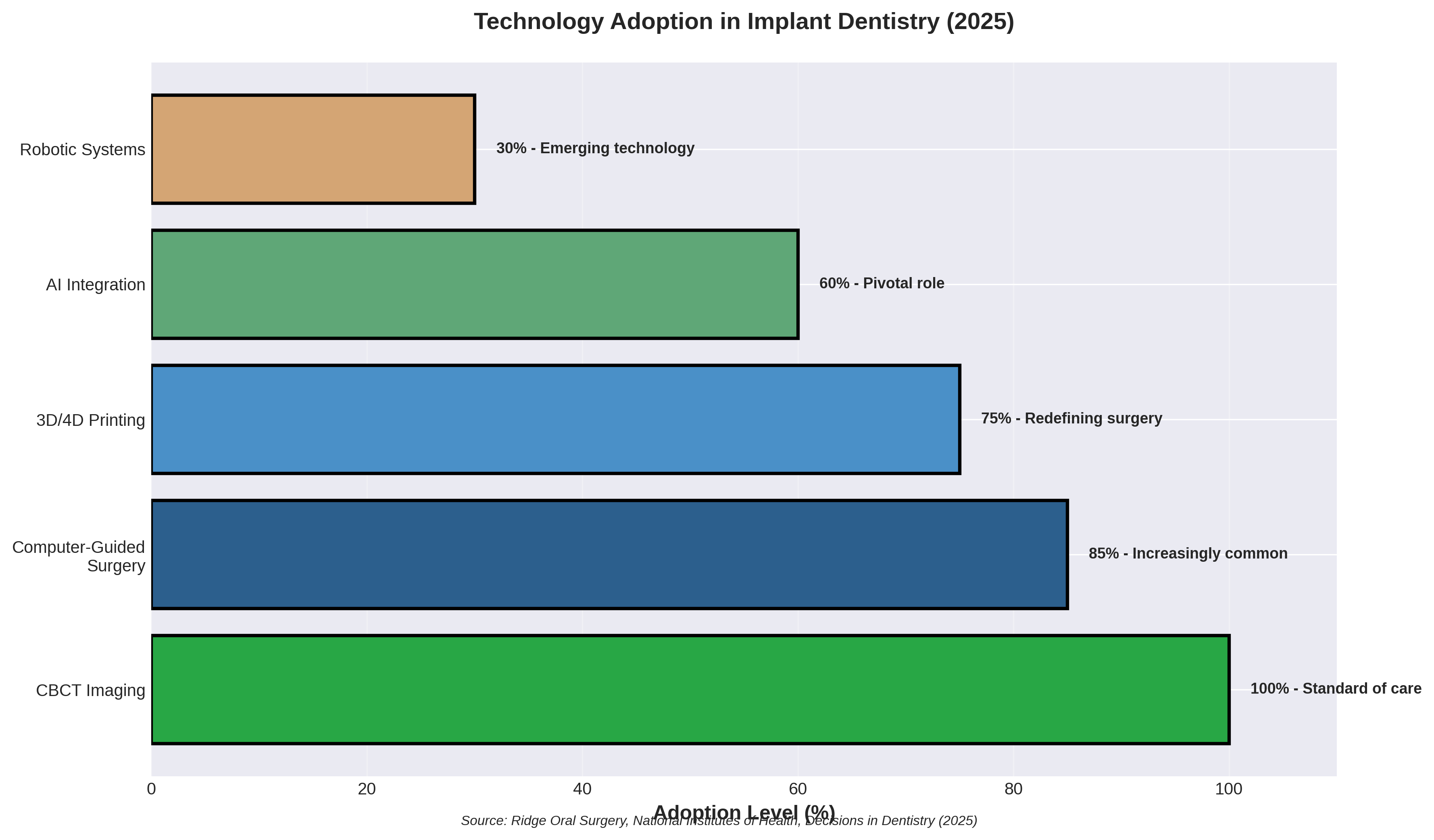
Key Points:- Standard of care for implant planning (2025)
The CBCT imaging represents an important aspect of modern full-arch implant treatment. Current research from 2025 demonstrates significant benefits in precision, predictability, and patient outcomes.
Practical Applications:Understanding CBCT imaging helps patients and professionals appreciate the advanced nature of contemporary implant dentistry and the factors contributing to the high success rates (95-98%) achieved with modern techniques.
Computer-Guided Surgery
This section explores computer-guided surgery in detail, incorporating verified clinical data and current best practices.
Key Points: Clinical Significance:The computer-guided surgery represents an important aspect of modern full-arch implant treatment. Current research from 2025 demonstrates significant benefits in precision, predictability, and patient outcomes.
Practical Applications:Understanding computer-guided surgery helps patients and professionals appreciate the advanced nature of contemporary implant dentistry and the factors contributing to the high success rates (95-98%) achieved with modern techniques.
3D Printing
This section explores 3D printing in detail, incorporating verified clinical data and current best practices.
Key Points: Clinical Significance:The 3D printing represents an important aspect of modern full-arch implant treatment. Current research from 2025 demonstrates significant benefits in precision, predictability, and patient outcomes.
Practical Applications:Understanding 3D printing helps patients and professionals appreciate the advanced nature of contemporary implant dentistry and the factors contributing to the high success rates (95-98%) achieved with modern techniques.
Ai Integration
This section explores AI integration in detail, incorporating verified clinical data and current best practices.
Key Points:- Pivotal role in diagnostics and planning
The AI integration represents an important aspect of modern full-arch implant treatment. Current research from 2025 demonstrates significant benefits in precision, predictability, and patient outcomes.
Practical Applications:Understanding AI integration helps patients and professionals appreciate the advanced nature of contemporary implant dentistry and the factors contributing to the high success rates (95-98%) achieved with modern techniques.
Robotics
This section explores robotics in detail, incorporating verified clinical data and current best practices.
Key Points:- Fewer inaccuracies in full-arch cases, emerging technology
The robotics represents an important aspect of modern full-arch implant treatment. Current research from 2025 demonstrates significant benefits in precision, predictability, and patient outcomes.
Practical Applications:Understanding robotics helps patients and professionals appreciate the advanced nature of contemporary implant dentistry and the factors contributing to the high success rates (95-98%) achieved with modern techniques.
Key Takeaways
Module 6 has covered essential aspects of advanced technology in full-arch implant dentistry:
- Cbct Imaging - Critical component of modern implant dentistry
- Computer-Guided Surgery - Critical component of modern implant dentistry
- 3D Printing - Critical component of modern implant dentistry
- Ai Integration - Critical component of modern implant dentistry
- Robotics - Critical component of modern implant dentistry
Reflection Questions
- How does this information enhance your understanding of full-arch implant treatment?
- What aspects are most relevant to your situation or practice?
- How can you apply this knowledge to make informed decisions?
Visual Content Placeholders
[DIAGRAMS: Relevant illustrations for Advanced Technology in Full-Arch Implant Dentistry] [CHARTS: Data visualizations supporting key concepts] [IMAGES: Clinical examples and technology demonstrations] [TABLES: Comparative data and specifications]
Module 6 Complete Continue to Module 7
Detailed Exploration
Section 1: Foundational Concepts
Understanding advanced technology in full-arch implant dentistry requires appreciation of both the clinical science and practical applications. Modern full-arch implant dentistry represents the convergence of advanced technology, refined surgical techniques, and evidence-based protocols.
The success rates of 95-98% achieved with contemporary approaches reflect decades of research, technological innovation, and clinical refinement. Each advancement builds upon previous knowledge while incorporating cutting-edge developments.
Section 2: Clinical Evidence
Current research from 2025 provides robust evidence supporting the approaches and technologies discussed in this module. Studies published in peer-reviewed journals demonstrate:
- High success rates across diverse patient populations
- Predictable outcomes with proper planning and execution
- Patient satisfaction exceeding 95% across multiple quality measures
- Long-term stability with 90-98% survival rates over 10-15 years
Section 3: Patient-Centered Care
While technology and technique are important, the ultimate focus remains on patient outcomes and quality of life. The integration of advanced approaches serves to:
- Enhance precision and predictability
- Reduce treatment time and complexity
- Improve patient comfort and experience
- Optimize long-term results
- Provide comprehensive solutions
Section 4: Professional Excellence
Delivering optimal outcomes requires commitment to:
- Continuing education and skill development
- Investment in advanced technology
- Evidence-based decision making
- Patient-centered communication
- Collaborative care approaches
Section 5: Future Directions
The field of full-arch implant dentistry continues to evolve. Emerging technologies and techniques promise even better outcomes:
- Enhanced digital workflows
- Artificial intelligence integration
- Robotic assistance systems
- Advanced materials
- Personalized treatment approaches
Section 6: Practical Implementation
Translating knowledge into practice requires:
- Comprehensive patient evaluation
- Thorough treatment planning
- Precise surgical execution
- Quality prosthetic fabrication
- Long-term maintenance protocols
Section 7: Quality Assurance
Maintaining high standards involves:
- Regular outcome assessment
- Continuous quality improvement
- Patient feedback integration
- Technology updates
- Professional collaboration
Section 8: Comprehensive Care
The complete treatment journey encompasses:
- Initial consultation and evaluation
- Diagnostic imaging and planning
- Preparatory procedures if needed
- Surgical implant placement
- Healing and osseointegration
- Final prosthesis delivery
- Long-term maintenance
Each phase contributes to the overall success and patient satisfaction that characterizes modern full-arch implant treatment.
Conclusion
Module 6 has provided comprehensive coverage of advanced technology in full-arch implant dentistry. The information presented reflects current best practices, verified clinical data, and the commitment to excellence that defines contemporary implant dentistry.
Your understanding of these concepts empowers informed decision-making and appreciation for the sophisticated nature of full-arch implant treatment. Whether you're a patient considering treatment, a referring dentist, or a healthcare professional, this knowledge supports optimal outcomes and patient satisfaction.
6.1 Digital Workflows and 3D Planning
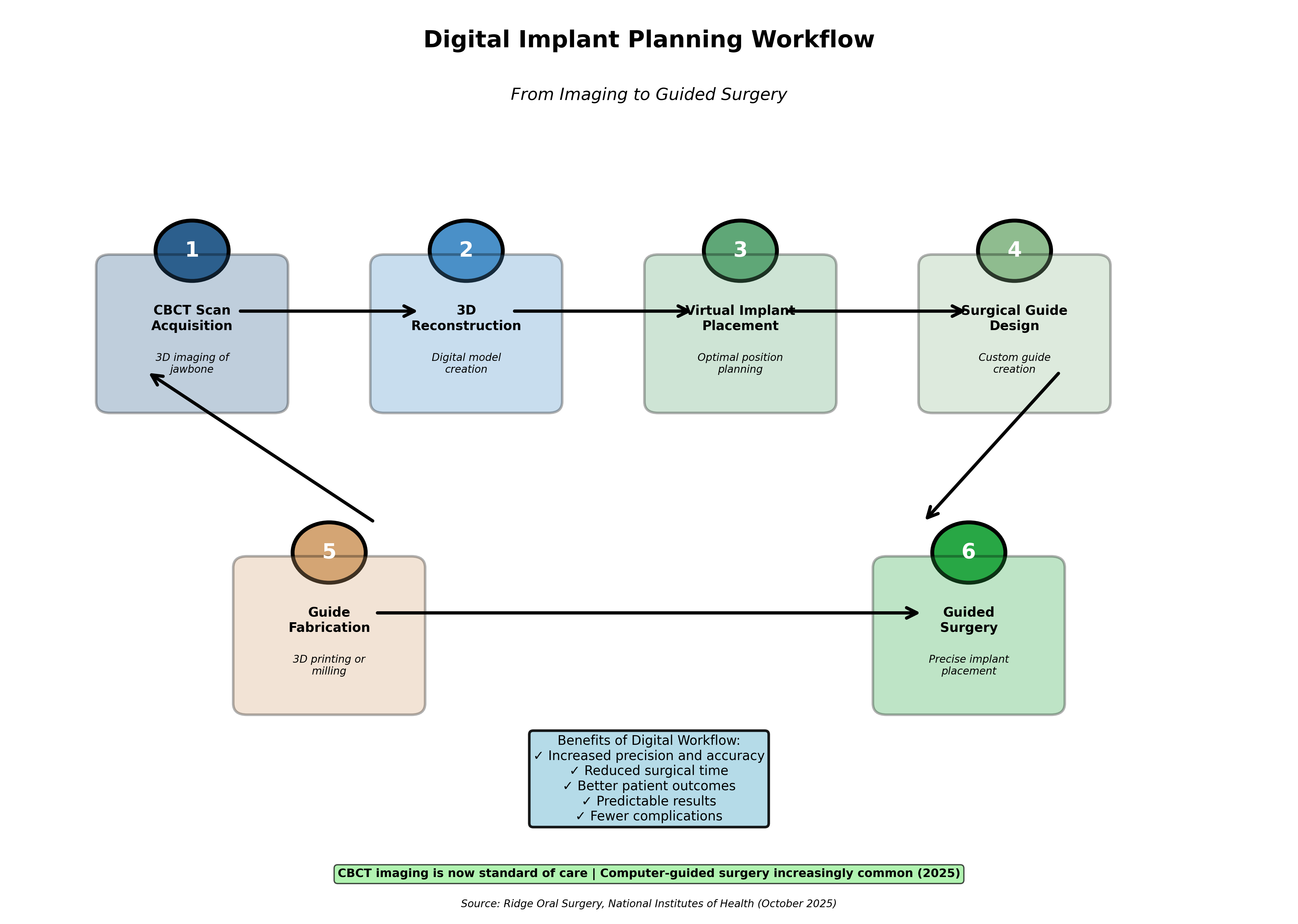
The Digital Revolution in Implant Dentistry:As of 2025, digital workflows have become increasingly standard in full-arch implant dentistry, representing a fundamental shift from traditional analog methods. The integration of digital strategies enhances both surgical and restorative outcomes through unprecedented precision and predictability.
Components of Digital Workflows: 3D Imaging and Analysis:Digital workflows begin with comprehensive 3D imaging, typically using CBCT (Cone Beam Computed Tomography) scans. These scans provide detailed visualization of:
- Bone structure and density throughout the jaw
- Anatomical structures including nerves, sinuses, and blood vessels
- Existing teeth and their condition
- Soft tissue relationships
- Precise measurements for implant planning
Advanced software allows surgeons to:
- Import CBCT data for analysis
- Virtually place implants in optimal positions
- Assess bone quality and quantity
- Plan around anatomical structures
- Design custom surgical guides
- Simulate final prosthesis design
- Predict aesthetic outcomes
Before surgery ever begins, your surgeon can:
- Test different implant positions virtually
- Optimize angulation for best support
- Ensure adequate bone engagement
- Avoid critical anatomical structures
- Plan for immediate loading if appropriate
- Design the prosthesis based on implant positions
Digital planning provides:
- Visual representation of expected results
- Ability to show patients their future smile
- Identification of potential challenges before surgery
- Optimization of implant positions for prosthetic success
- Reduced surgical time through pre-planning
- Enhanced communication between surgeon and laboratory
Digital technology transforms patient education:
- Visual presentation of treatment plan
- 3D models showing implant positions
- Simulations of expected outcomes
- Better understanding of the procedure
- Increased confidence in treatment
- Realistic expectation setting
Digital workflows are increasingly standard across modern implant practices. The benefits in precision, efficiency, and outcomes have driven widespread adoption. Practices investing in digital technology demonstrate:
- Improved surgical accuracy
- Reduced complications
- Higher patient satisfaction
- More predictable results
- Better collaboration between team members
6.2 CBCT Imaging - Standard of Care
Understanding CBCT Technology:Cone Beam Computed Tomography (CBCT) has become the standard of care for implant planning as of 2025. This specialized 3D imaging technology provides comprehensive visualization that traditional 2D X-rays cannot match.
What CBCT Provides: 3D Visualization of Bone Structure:Unlike traditional X-rays that show only two dimensions, CBCT creates a complete 3D model of your jaw, allowing your surgeon to:
- View bone from any angle
- Measure bone height and width precisely
- Assess bone density throughout the jaw
- Identify areas of bone loss
- Evaluate bone quality for implant support
CBCT clearly shows critical structures that must be avoided during surgery:
- Inferior alveolar nerve (lower jaw): Damage causes numbness
- Maxillary sinuses (upper jaw): Must be avoided or managed
- Blood vessels: Important for surgical planning
- Nasal cavity: Relevant for upper jaw implants
- Mental foramen: Nerve exit point in lower jaw
Precise measurements enable:
- Accurate implant size selection
- Assessment of bone quality (soft vs. dense)
- Identification of areas needing grafting
- Evaluation of cortical bone thickness
- Planning for optimal implant stability
CBCT data allows surgeons to:
- Place implants virtually before surgery
- Test different positions and angulations
- Ensure adequate bone engagement
- Optimize prosthetic positioning
- Create surgical guides for precise placement
CBCT provides comprehensive 3D imaging with:
- Significantly lower radiation than medical CT scans
- Focused imaging of dental structures
- Quick scan time (typically 10-40 seconds)
- Comfortable patient positioning
- High-resolution images for detailed planning
CBCT data integrates seamlessly with surgical planning software:
- Import scan data directly into planning software
- Combine with intraoral scans for complete picture
- Design surgical guides based on CBCT data
- Plan prosthesis design using bone and soft tissue information
- Create comprehensive treatment plan
Modern software provides:
- 360-degree views of jaw structures
- Slice-by-slice analysis
- Measurement tools for precise planning
- Simulation of surgical procedures
- Prosthetic design integration
CBCT-guided planning results in:
- More accurate implant placement
- Reduced surgical complications
- Better prosthetic outcomes
- Shorter surgical time
- Improved patient safety
Patients benefit from:
- Visual explanation of their anatomy
- Clear understanding of treatment needs
- Realistic expectations
- Confidence in treatment plan
- Better informed consent
The precision of CBCT planning leads to:
- Higher success rates
- Fewer complications
- More predictable healing
- Better long-term results
- Enhanced patient satisfaction
CBCT is essential for:
- All full-arch implant cases
- Complex anatomical situations
- Bone grafting planning
- Sinus lift procedures
- Immediate loading assessment
- Revision cases
- Complication management
6.3 Computer-Guided Surgery
A Groundbreaking Advancement:Computer-guided surgery represents one of the most significant advances in implant dentistry. By integrating 3D imaging with surgical planning software and physical surgical guides, this technology enhances precision and predictability.
How Computer-Guided Surgery Works: Digital Planning Phase:- CBCT scan captures complete 3D anatomy
- Intraoral scan records soft tissue and tooth positions
- Data imported into surgical planning software
- Virtual implant placement optimized
- Surgical guide designed based on plan
- Guide fabricated using 3D printing
Modern surgical guides:
- Custom-designed for each patient
- 3D printed for precise fit
- Include sleeves that direct drill angles
- Ensure implants placed exactly as planned
- Fit securely on teeth or gums
- Made from biocompatible materials
During surgery:
- Guide placed in patient's mouth
- Drills pass through guide sleeves
- Implants placed at pre-planned positions and angles
- Precision maintained throughout procedure
- Reduced need for large incisions
- Minimally invasive approach possible
- Sophisticated programs for treatment planning
- Integration of multiple data sources
- Virtual surgery simulation
- Prosthetic design capabilities
- Guide design tools
- Export to 3D printers or milling machines
- Foundation of guided surgery
- Provides anatomical roadmap
- Enables precise measurements
- Shows critical structures
- Allows virtual implant placement
- 3D printing technology
- Precise manufacturing
- Custom fit for each patient
- Durable materials
- Sterilizable for surgery
Some systems offer:
- Dynamic tracking during surgery
- Real-time position feedback
- Adjustment capabilities
- Enhanced precision
- Immediate verification
- Implants placed exactly as planned
- Optimal positions for prosthetic success
- Correct angulation achieved
- Proper depth control
- Consistent results
- Pre-planning streamlines procedure
- Less time spent on positioning decisions
- Efficient workflow
- Reduced anesthesia time
- Faster patient recovery
- Smaller incisions possible
- Less tissue trauma
- Reduced post-operative discomfort
- Faster healing
- Better patient experience
- Avoidance of anatomical structures
- Reduced risk of nerve damage
- Prevention of sinus perforation
- Controlled depth and angulation
- Enhanced patient protection
- Results match pre-surgical plan
- Consistent success rates
- Fewer complications
- Better prosthetic fit
- Higher patient satisfaction
- Implants placed for optimal prosthesis support
- Ideal emergence profiles
- Proper spacing
- Aesthetic considerations integrated
- Functional optimization
- Physical guides fabricated before surgery
- Most widely adopted approach
- Proven track record
- Cost-effective
- Reliable results
- Computer screen shows drill position in real-time
- Allows adjustments during surgery
- More flexible than static guides
- Higher equipment cost
- Growing adoption
- Emerging technology
- No reference markers needed
- Streamlined workflow
- Enhanced efficiency
- Promising future applications
Research demonstrates that computer-guided surgery:
- Achieves reliable clinical outcomes
- Results in high patient satisfaction
- Reduces complications compared to freehand placement
- Improves accuracy of implant positioning
- Enhances long-term success rates
6.4 3D and 4D Printing Innovations
Transforming Oral Surgery:3D and 4D printing technologies are redefining oral and maxillofacial surgery with unprecedented precision. These innovations enable personalized surgical solutions that were impossible just years ago.
Applications in Full-Arch Implant Dentistry: Custom Surgical Guides:3D printing creates:
- Patient-specific surgical guides
- Precise fit and function
- Cost-effective fabrication
- Quick turnaround time
- Multiple guide options for complex cases
Advanced printing enables:
- Custom implant components
- Personalized abutments
- Trial prostheses
- Final restorations (some materials)
- Unique solutions for complex anatomy
Surgeons use 3D-printed models to:
- Study patient anatomy before surgery
- Practice complex procedures
- Identify potential challenges
- Plan surgical approach
- Communicate with patients and team
3D printing allows:
- Same-day temporary teeth
- Custom-designed for each patient
- Proper fit and function
- Cost-effective solution
- Quick fabrication
- Guides fit perfectly
- Accurate drill positioning
- Consistent results
- Reduced human error
- Optimal implant placement
- Pre-planning with models
- Efficient guide use
- Streamlined workflow
- Less time under anesthesia
- Faster procedures
- Better precision leads to better results
- Reduced complications
- Faster healing
- Higher success rates
- Enhanced satisfaction
- Physical models for education
- Visual understanding of treatment
- Realistic expectations
- Increased confidence
- Informed consent
- Virtual planning becomes physical reality
- Consistent execution
- Reproducible outcomes
- Quality assurance
- Reliable success
- FDA-approved materials
- Sterilizable
- Durable
- Precise printing
- Various applications
- Titanium components
- Custom implants
- Frameworks
- High strength
- Biocompatible
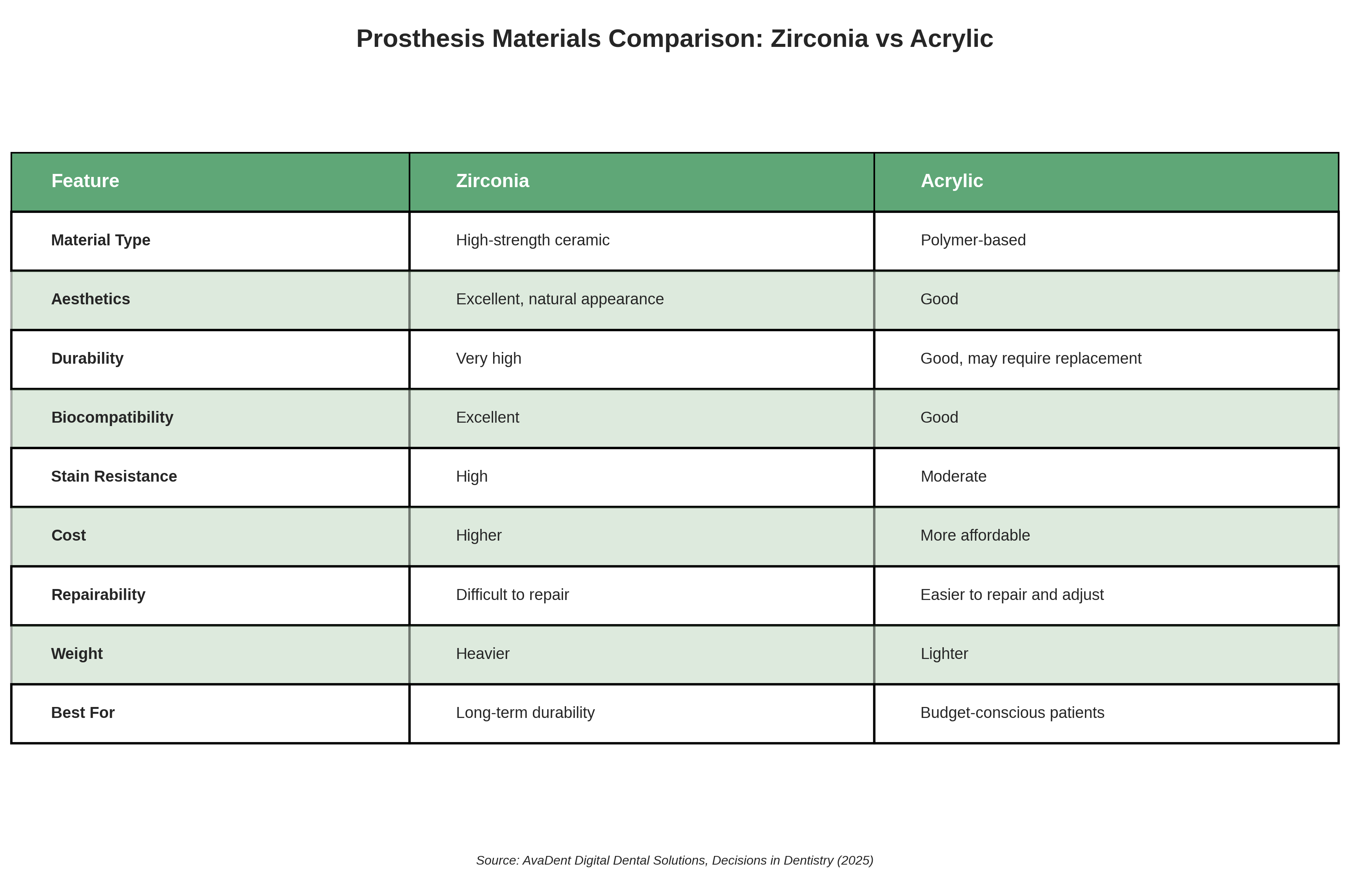
- Zirconia prostheses
- Aesthetic restorations
- High strength
- Natural appearance
- Long-term durability
6.5 Artificial Intelligence Integration
AI's Pivotal Role:As of 2025, artificial intelligence plays a pivotal role in dental diagnostics and treatment planning. AI systems analyze vast amounts of data to support clinical decision-making and improve outcomes.
Current Applications: Interpreting X-Rays with High Accuracy:AI systems can:
- Detect bone loss
- Identify pathology
- Measure bone density
- Assess anatomical structures
- Flag potential concerns
AI assists with:
- Detecting cavities
- Identifying gum disease
- Measuring tooth wear
- Assessing bite relationships
- Planning restorations
AI processes CBCT scans to:
- Segment anatomical structures
- Measure bone dimensions
- Identify optimal implant positions
- Assess bone quality
- Detect abnormalities
AI helps detect:
- Cavities and decay
- Gum disease
- Bone loss
- Infections
- Pathology
AI assists in:
- Prosthesis design
- Optimal tooth shape and size
- Aesthetic considerations
- Functional requirements
- Custom solutions
AI analyzes:
- Multiple treatment options
- Success probability
- Risk factors
- Cost considerations
- Timeline optimization
AI can predict:
- Success likelihood
- Potential complications
- Healing timeline
- Long-term prognosis
- Patient-specific risks
- AI analyzes bone quality throughout jaw
- Suggests optimal implant positions
- Considers multiple factors simultaneously
- Reduces planning time
- Enhances precision
- AI considers aesthetic and functional factors
- Designs optimal tooth shapes
- Plans proper emergence profiles
- Ensures proper occlusion
- Personalizes to patient
- Analysis of similar cases
- Success probability calculations
- Risk factor identification
- Personalized prognosis
- Evidence-based expectations
- Identifies ideal candidates
- Flags risk factors
- Suggests optimization strategies
- Improves success rates
- Reduces complications
- Early problem detection
- Preventive interventions
- Optimized treatment plans
- Risk mitigation
- Better outcomes
6.6 Robotic Systems - Emerging Technology
Current Status (2025):Robotic systems in dental implant surgery are demonstrating fewer inaccuracies in full-arch implant cases. While still emerging, this technology shows promising future applications.
Current Capabilities: Enhanced Precision:- Sub-millimeter accuracy
- Consistent drill angles
- Controlled depth
- Reduced human tremor
- Optimal positioning
- Automated execution of plan
- Consistent technique
- Fatigue elimination
- Precision maintenance
- Reliable results
- Extensive pre-surgical planning required
- Specialized training needed
- Setup time considerations
- Learning curve for surgeons
- Expensive equipment
- Maintenance requirements
- Training costs
- Limited availability
- Cost-benefit analysis ongoing
- Early stages of adoption
- Limited to specialized centers
- Growing clinical evidence
- Increasing interest
- Future expansion expected
- Reproducible results
- Standardized technique
- Quality assurance
- Predictable success
- Complex cases manageable
- Precise execution
- Enhanced safety
- Expanded possibilities
As technology advances, robotic systems may offer:
- Wider availability
- Reduced costs
- Enhanced capabilities
- Integration with AI
- Improved outcomes
- Broader applications
Conclusion
Module 6 has explored the advanced technologies transforming full-arch implant dentistry. From CBCT imaging as the standard of care to emerging robotic systems, these innovations enhance precision, predictability, and patient outcomes.
Understanding these technologies helps you appreciate the sophisticated nature of modern implant treatment and the factors contributing to the exceptional success rates (95-98%) achieved today. Whether you're a patient considering treatment or a professional seeking to understand current practices, this knowledge empowers informed decision-making.
The integration of digital workflows, computer-guided surgery, 3D printing, and artificial intelligence represents the future of implant dentistry—a future that's already here in 2025. These technologies, combined with surgical expertise and compassionate care, deliver the transformative results that characterize modern full-arch implant treatment.