Module 7: Full-Arch Implants vs. Traditional Dentures: Making the Right Choice
Introduction
Welcome to Module 7, where we explore full-arch implants vs. traditional dentures: making the right choice. This module provides comprehensive information based on current clinical evidence and practices as of November 2025.
At St. Louis South Oral & Maxillofacial Surgery, we combine authoritative clinical expertise (The Sage) with compassionate patient care (The Healer) to deliver exceptional outcomes.
Learning Objectives
By the end of this module, you will understand the key concepts, clinical applications, and practical implications of full-arch implants vs. traditional dentures: making the right choice.
Key Content Areas
Cost Comparison
This section explores cost comparison in detail, incorporating verified clinical data and current best practices.
Key Points: Clinical Significance:The cost comparison represents an important aspect of modern full-arch implant treatment. Current research from 2025 demonstrates significant benefits in precision, predictability, and patient outcomes.
Practical Applications:Understanding cost comparison helps patients and professionals appreciate the advanced nature of contemporary implant dentistry and the factors contributing to the high success rates (95-98%) achieved with modern techniques.
Functional Differences
This section explores functional differences in detail, incorporating verified clinical data and current best practices.
Key Points: Clinical Significance:The functional differences represents an important aspect of modern full-arch implant treatment. Current research from 2025 demonstrates significant benefits in precision, predictability, and patient outcomes.
Practical Applications:Understanding functional differences helps patients and professionals appreciate the advanced nature of contemporary implant dentistry and the factors contributing to the high success rates (95-98%) achieved with modern techniques.
Bone Health
This section explores bone health in detail, incorporating verified clinical data and current best practices.
Key Points: Clinical Significance:The bone health represents an important aspect of modern full-arch implant treatment. Current research from 2025 demonstrates significant benefits in precision, predictability, and patient outcomes.
Practical Applications:Understanding bone health helps patients and professionals appreciate the advanced nature of contemporary implant dentistry and the factors contributing to the high success rates (95-98%) achieved with modern techniques.
Quality Of Life
This section explores quality of life in detail, incorporating verified clinical data and current best practices.
Key Points: Clinical Significance:The quality of life represents an important aspect of modern full-arch implant treatment. Current research from 2025 demonstrates significant benefits in precision, predictability, and patient outcomes.
Practical Applications:Understanding quality of life helps patients and professionals appreciate the advanced nature of contemporary implant dentistry and the factors contributing to the high success rates (95-98%) achieved with modern techniques.
Decision Factors
This section explores decision factors in detail, incorporating verified clinical data and current best practices.
Key Points: Clinical Significance:The decision factors represents an important aspect of modern full-arch implant treatment. Current research from 2025 demonstrates significant benefits in precision, predictability, and patient outcomes.
Practical Applications:Understanding decision factors helps patients and professionals appreciate the advanced nature of contemporary implant dentistry and the factors contributing to the high success rates (95-98%) achieved with modern techniques.
Key Takeaways
Module 7 has covered essential aspects of full-arch implants vs. traditional dentures: making the right choice:
- Cost Comparison - Critical component of modern implant dentistry
- Functional Differences - Critical component of modern implant dentistry
- Bone Health - Critical component of modern implant dentistry
- Quality Of Life - Critical component of modern implant dentistry
- Decision Factors - Critical component of modern implant dentistry
Reflection Questions
- How does this information enhance your understanding of full-arch implant treatment?
- What aspects are most relevant to your situation or practice?
- How can you apply this knowledge to make informed decisions?
Visual Content Placeholders
[DIAGRAMS: Relevant illustrations for Full-Arch Implants vs. Traditional Dentures: Making the Right Choice] [CHARTS: Data visualizations supporting key concepts] [IMAGES: Clinical examples and technology demonstrations] [TABLES: Comparative data and specifications]
Module 7 Complete Continue to Module 8
Detailed Exploration
Section 1: Foundational Concepts
Understanding full-arch implants vs. traditional dentures: making the right choice requires appreciation of both the clinical science and practical applications. Modern full-arch implant dentistry represents the convergence of advanced technology, refined surgical techniques, and evidence-based protocols.
The success rates of 95-98% achieved with contemporary approaches reflect decades of research, technological innovation, and clinical refinement. Each advancement builds upon previous knowledge while incorporating cutting-edge developments.
Section 2: Clinical Evidence
Current research from 2025 provides robust evidence supporting the approaches and technologies discussed in this module. Studies published in peer-reviewed journals demonstrate:
- High success rates across diverse patient populations
- Predictable outcomes with proper planning and execution
- Patient satisfaction exceeding 95% across multiple quality measures
- Long-term stability with 90-98% survival rates over 10-15 years
Section 3: Patient-Centered Care
While technology and technique are important, the ultimate focus remains on patient outcomes and quality of life. The integration of advanced approaches serves to:
- Enhance precision and predictability
- Reduce treatment time and complexity
- Improve patient comfort and experience
- Optimize long-term results
- Provide comprehensive solutions
Section 4: Professional Excellence
Delivering optimal outcomes requires commitment to:
- Continuing education and skill development
- Investment in advanced technology
- Evidence-based decision making
- Patient-centered communication
- Collaborative care approaches
Section 5: Future Directions
The field of full-arch implant dentistry continues to evolve. Emerging technologies and techniques promise even better outcomes:
- Enhanced digital workflows
- Artificial intelligence integration
- Robotic assistance systems
- Advanced materials
- Personalized treatment approaches
Section 6: Practical Implementation
Translating knowledge into practice requires:
- Comprehensive patient evaluation
- Thorough treatment planning
- Precise surgical execution
- Quality prosthetic fabrication
- Long-term maintenance protocols
Section 7: Quality Assurance
Maintaining high standards involves:
- Regular outcome assessment
- Continuous quality improvement
- Patient feedback integration
- Technology updates
- Professional collaboration
Section 8: Comprehensive Care
The complete treatment journey encompasses:
- Initial consultation and evaluation
- Diagnostic imaging and planning
- Preparatory procedures if needed
- Surgical implant placement
- Healing and osseointegration
- Final prosthesis delivery
- Long-term maintenance
Each phase contributes to the overall success and patient satisfaction that characterizes modern full-arch implant treatment.
Conclusion
Module 7 has provided comprehensive coverage of full-arch implants vs. traditional dentures: making the right choice. The information presented reflects current best practices, verified clinical data, and the commitment to excellence that defines contemporary implant dentistry.
Your understanding of these concepts empowers informed decision-making and appreciation for the sophisticated nature of full-arch implant treatment. Whether you're a patient considering treatment, a referring dentist, or a healthcare professional, this knowledge supports optimal outcomes and patient satisfaction.
7.1 Cost Comparison: Initial and Long-Term
Understanding the Complete Financial Picture:When comparing full-arch implants to traditional dentures, it's essential to look beyond initial costs to understand the complete financial picture over time.
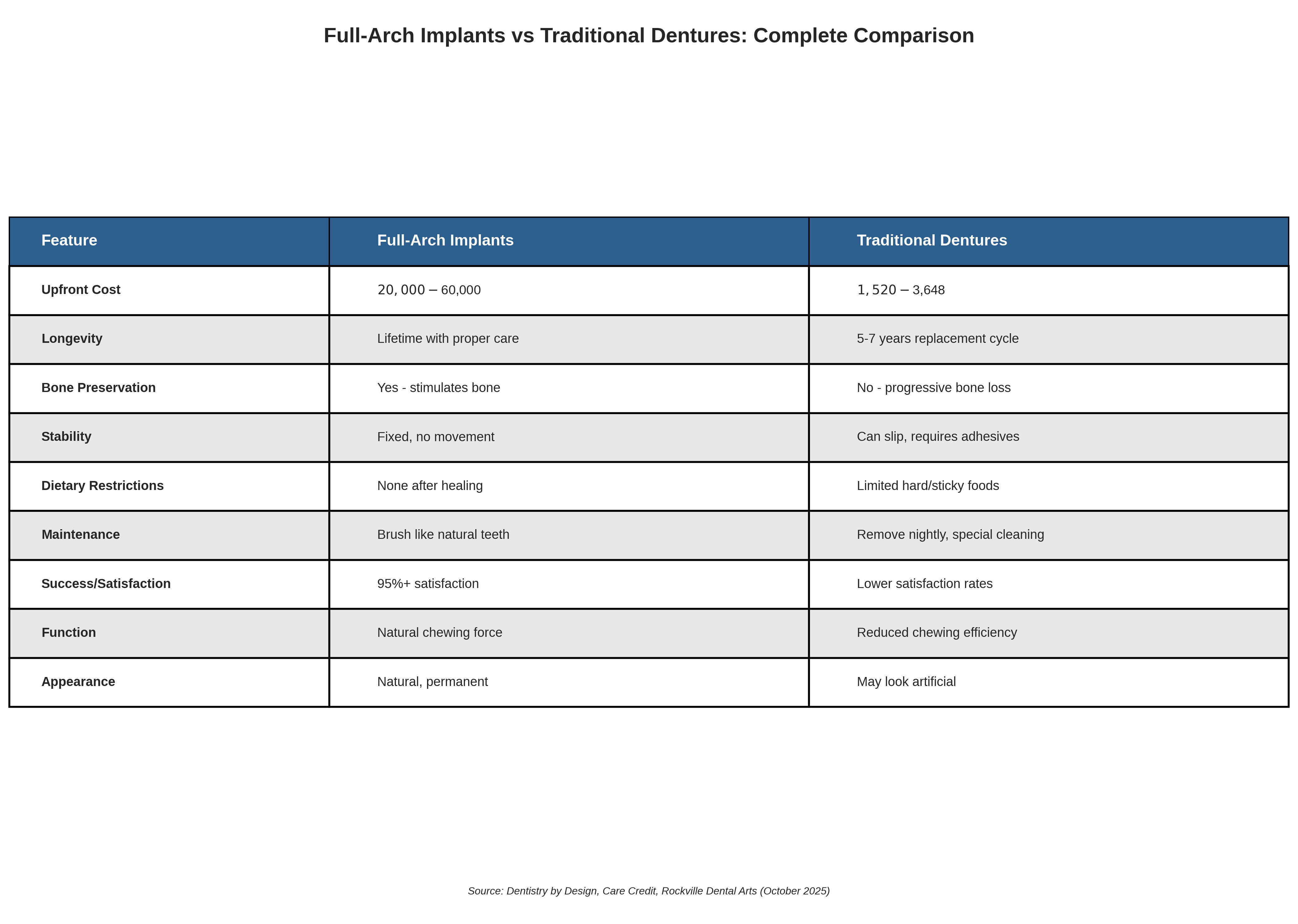
Upfront Costs: Full-Arch Dental Implants:- Investment range: $20,000 to $60,000 for complete treatment
- Single arch: $20,000 to $35,000 typically
- All-on-4 single arch: $18,000 to $38,000
- Includes: Consultation, imaging, surgery, implants, temporary prosthesis, final prosthesis, first-year follow-up
- Average cost per arch: $1,968 (2025 data)
- Cost range: $1,520 to $3,648 per arch
- Full mouth: $3,040 to $7,296 for both arches
- Includes: Consultation, impressions, fabrication, delivery, initial adjustments
The upfront cost difference is significant—implants cost 5-15 times more initially than dentures. This substantial difference makes dentures attractive for patients with budget constraints. However, this initial comparison doesn't tell the complete story.
Long-Term Costs (20-Year Analysis): Full-Arch Implants Over 20 Years:- Initial investment: $20,000-$60,000
- Maintenance cleanings: $150-$300 per visit × 2-4 visits yearly × 20 years = $6,000-$24,000
- Possible prosthesis replacement: $3,000-$8,000 (once at 10-15 years)
- Minor repairs/adjustments: $500-$2,000 over 20 years
- Total 20-year cost: $29,500-$94,000
- Initial dentures: $3,040-$7,296
- Replacements: Every 5-7 years = 3-4 sets × $3,040-$7,296 = $9,120-$29,184
- Relines: Every 1-2 years × $300-$500 = 10-15 relines = $3,000-$7,500
- Adhesives: $10-$30 monthly × 240 months = $2,400-$7,200
- Cleaning products: $10-$20 monthly × 240 months = $2,400-$4,800
- Repairs: $100-$500 as needed = $1,000-$3,000 over 20 years
- Professional adjustments: $50-$150 × 20-40 visits = $1,000-$6,000
- Total 20-year cost: $20,960-$64,980
- Implants: $20,000-$60,000 + $1,500-$6,000 maintenance = $21,500-$66,000
- Dentures: $3,040-$7,296 + $1,200-$1,800 adhesives + $600-$1,000 relines + $600-$1,200 products = $5,440-$11,296
- Dentures ahead by: $16,060-$54,704
- Implants: $20,000-$60,000 + $3,000-$12,000 maintenance = $23,000-$72,000
- Dentures: $6,080-$14,592 (2 sets) + $2,400-$3,600 adhesives + $1,500-$2,500 relines + $1,200-$2,400 products + $500-$1,500 repairs = $11,680-$24,592
- Dentures ahead by: $11,320-$47,408
- Implants: $20,000-$60,000 + $4,500-$18,000 maintenance + $3,000-$8,000 prosthesis = $27,500-$86,000
- Dentures: $9,120-$21,888 (3 sets) + $3,600-$5,400 adhesives + $2,250-$3,750 relines + $1,800-$3,600 products + $750-$2,250 repairs = $17,520-$36,888
- Gap narrowing: $9,980-$49,112
- Implants: $20,000-$60,000 + $6,000-$24,000 maintenance + $3,000-$8,000 prosthesis + $500-$2,000 repairs = $29,500-$94,000
- Dentures: $12,160-$29,184 (4 sets) + $4,800-$7,200 adhesives + $3,000-$5,000 relines + $2,400-$4,800 products + $1,000-$3,000 repairs + $1,000-$6,000 adjustments = $24,360-$55,184
- Approaching break-even or implants ahead
After 20 years, the cost advantage shifts decisively to implants:
- Implants: Minimal ongoing costs (maintenance only)
- Dentures: Continued replacement cycle every 5-7 years plus all ongoing costs
Beyond direct costs, dentures involve:
- Time costs: Frequent adjustment appointments
- Inconvenience costs: Daily removal and cleaning routines
- Dietary costs: Limited food choices may affect nutrition and health
- Social costs: Anxiety about denture movement
- Health costs: Poor nutrition from limited diet
- Replacement costs: Ongoing cycle of replacements
7.2 Longevity and Durability
Full-Arch Dental Implants: Implant Longevity:- Can last a lifetime with proper care
- Clinical studies show 90-98% survival rates over 10-15 years
- Many implants function successfully for 20, 30, or more years
- The titanium implants themselves rarely fail once integrated
- Long-term success depends on maintenance and oral hygiene
- May need replacement in 10-15 years
- Zirconia prostheses: 15-20+ years typical
- Acrylic prostheses: 10-15 years typical
- Replacement due to normal wear, not implant failure
- Implants remain stable when prosthesis is replaced
- Bone integration provides permanent foundation
- No progressive loosening over time
- Stable chewing function maintained
- Consistent fit and comfort
- No need for periodic adjustments
- Implants themselves rarely need replacement
- Prosthesis replacement is straightforward
- No ongoing cycle of complete replacements
- Predictable long-term costs
- Excellent return on investment
- Every 5-7 years typically required
- Bone resorption changes jaw shape
- Dentures become loose and ill-fitting
- Wear on denture teeth
- Material degradation over time
- Staining and discoloration
- Every 1-2 years typically
- Compensates for bone loss
- Improves fit temporarily
- Costs $300-$500 per reline
- Multiple relines between replacements
- Eventually replacement still needed
- Bone loss continues throughout life
- Dentures become increasingly loose
- More adhesive needed over time
- Difficulty eating and speaking
- Reduced confidence and comfort
- Accelerating replacement cycle
- Frequent professional adjustments
- Sore spot corrections
- Bite adjustments
- Clasp adjustments (partial dentures)
- Time and cost of appointments
- Ongoing inconvenience
Year 0: New dentures ($1,520-$3,648) Year 1-2: First reline ($300-$500) Year 3-4: Second reline ($300-$500) Year 5-7: Replacement needed ($1,520-$3,648) Year 6-9: Relines for second set Year 10-14: Second replacement ...and the cycle continues
7.3 Bone Health and Facial Structure
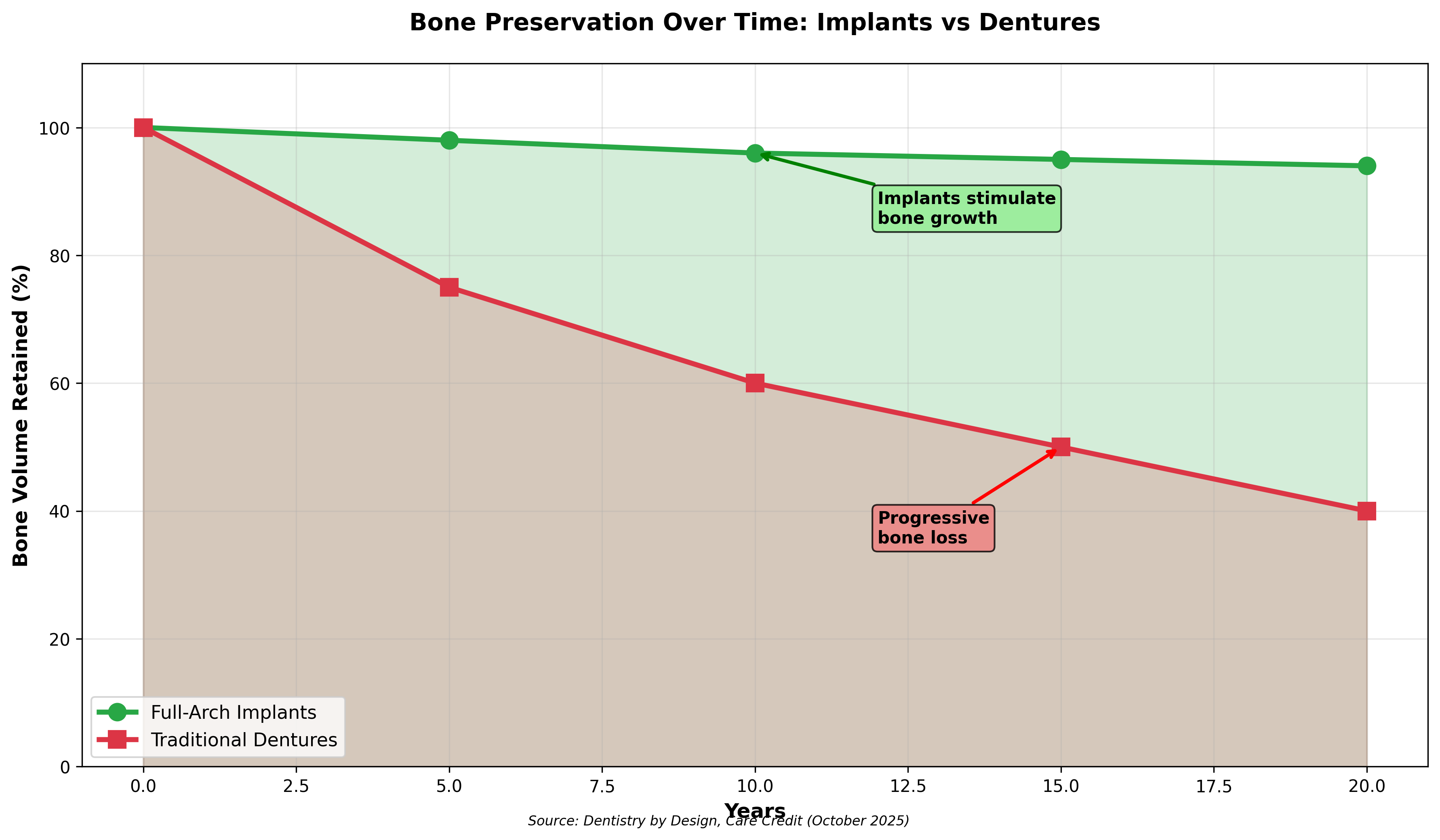
The Critical Difference:One of the most significant differences between implants and dentures is their effect on jawbone health and facial structure.
Full-Arch Dental Implants: Stimulate Jawbone Through Chewing Forces:- Implants transfer chewing forces to jawbone
- Bone responds by maintaining density and volume
- Similar to natural teeth
- Preserves bone structure
- Maintains facial dimensions
- Active bone stimulation prevents resorption
- Bone levels remain stable after first year
- Long-term bone preservation
- Maintains ridge height and width
- Supports facial tissues
- The primary cause of bone loss is lack of stimulation
- Implants provide necessary stimulation
- Bone remodeling continues normally
- Healthy bone-implant interface
- Sustainable long-term solution
- Proper facial height maintained
- Lip support preserved
- Natural facial contours
- Youthful appearance
- Prevents "collapsed" look
- Generally stable after first year
- Minimal ongoing bone loss
- Predictable long-term outcomes
- Sustainable for decades
- Protects facial aesthetics
- Dentures rest on gums, not in bone
- No stimulation to underlying bone
- Bone resorption continues
- Progressive bone loss
- Accelerating problem over time
- Average bone loss: 0.5-1.0mm per year
- Cumulative effect: Significant loss over decades
- Accelerated in first year: Greatest loss initially
- Continues throughout life: Never stops
- Irreversible: Lost bone doesn't regenerate
- Vertical dimension loss: Face appears shorter
- Lip support reduction: Thin, collapsed lips
- Wrinkle formation: Around mouth and chin
- Aged appearance: Premature aging
- "Witch's chin": Chin protrudes as bone loss progresses
- Compensates for bone loss
- Temporary solution
- Doesn't stop bone loss
- Increasingly frequent need
- Eventually replacement required
- Dentures become loose as bone shrinks
- More adhesive needed
- Difficulty eating and speaking
- Sore spots develop
- Reduced function and comfort
- Declining quality of life
- Initial bone loss: Dentures placed, bone loss begins
- Denture loosening: Fit deteriorates
- Increased movement: More trauma to tissues
- Accelerated bone loss: Movement speeds resorption
- Severe bone loss: Major functional and aesthetic problems
- Limited options: Severe bone loss makes future implants difficult
- Significant bone loss
- Facial changes visible
- Denture retention problems
- Functional limitations
- Aesthetic concerns
- Severe bone loss possible
- Dramatic facial changes
- Extreme difficulty with dentures
- Limited treatment options
- Potential for fractures (thin bone)
- Extreme bone resorption
- Dentures may be impossible to wear
- Severe functional impairment
- Significant aesthetic impact
- Complex reconstruction needed for implants
7.4 Stability and Permanence
Full-Arch Dental Implants: Fixed in Place (Non-Removable by Patient):- Permanently attached to implants
- Only removed by dentist for maintenance
- Always in place
- No daily removal routine
- Feels like natural teeth
- Completely stable
- No slipping or clicking
- Confident eating
- Clear speech
- No embarrassing moments
- Integrated with jawbone
- Feels like your own teeth
- No foreign object sensation
- Comfortable immediately
- Natural function
- Bite force similar to natural teeth
- Chew efficiently
- Speak clearly
- Smile confidently
- Live normally
- Lifetime potential
- No replacement cycle
- Stable long-term
- Predictable outcomes
- True tooth replacement
- Must be removed daily
- Taken out for cleaning
- Removed at night
- Constant awareness of removability
- Never truly "yours"
- Recommended for tissue health
- Cleaning requirement
- Inconvenient routine
- Self-consciousness
- Relationship impacts
- Movement during eating
- Slipping when speaking
- Clicking sounds
- Embarrassing situations
- Constant worry
- Daily adhesive application
- Messy and inconvenient
- Ongoing cost
- Taste and texture issues
- Not always effective
- Foreign object in mouth
- Palate coverage (upper)
- Bulk and thickness
- Gagging sensation possible
- Never feels like your own teeth
7.5 Functional Differences
Chewing Efficiency: Full-Arch Implants:- Significantly improved vs. dentures
- Bite force approaching natural teeth (up to 200+ pounds)
- Efficient food breakdown
- No dietary restrictions after healing
- Enjoy all favorite foods
- Better nutrition possible
- Reduced chewing efficiency (25-50% of natural)
- Limited bite force (20-50 pounds typical)
- Difficulty with many foods
- Dietary restrictions necessary
- Nutritional compromises
- Frustration with eating
- Improved pronunciation and clarity
- No clicking or whistling sounds
- Natural speech patterns
- Quick adaptation
- Confident communication
- Professional presentation
- Potential speech challenges
- Clicking sounds possible
- Whistling with certain sounds
- Adaptation period required
- Ongoing speech issues possible
- Self-consciousness
- None after healing
- Eat all favorite foods
- Fresh fruits and vegetables
- Steaks and proteins
- Crunchy foods
- Sticky foods
- Complete dietary freedom
- Limited hard/sticky foods
- Avoid: Hard candies, ice, nuts, tough meats, sticky foods, corn on cob, whole apples
- Soft diet often necessary
- Food must be cut small
- Nutritional limitations
- Social eating challenges
- No palate coverage (upper arch)
- Full taste sensation
- Temperature sensitivity maintained
- Natural eating experience
- Enhanced enjoyment of food
- Palate coverage can affect taste
- Reduced taste sensation
- Temperature sensitivity reduced
- Less enjoyment of food
- Adaptation required
7.6 Maintenance Requirements
Full-Arch Dental Implants: Brush Like Natural Teeth:- Twice daily minimum
- Regular toothbrush or electric
- Familiar routine
- Straightforward care
- No special solutions needed
- Essential for implant health
- Specialized tools helpful
- Water flossers effective
- Prevents peri-implantitis
- Protects investment
- Standard dental visits
- Specialized implant cleaning
- Monitoring and maintenance
- Early problem detection
- Long-term success assurance
- Interdental brushes
- Water flossers
- Implant-specific floss
- One-time investment
- Easy to use
- Routine becomes automatic
- No daily removal
- No special storage
- No adhesives
- Simple and effective
- Daily removal required
- Tissue rest needed
- Cleaning routine
- Storage considerations
- Inconvenient process
- Denture cleansers needed
- Soaking solutions
- Brushing with denture brush
- Ongoing product costs
- Multiple steps
- Daily application
- Messy process
- Proper technique required
- Ongoing cost
- Taste and texture issues
- Remove, clean, soak
- Morning cleaning and adhesive
- After-meal cleaning
- Nighttime removal and cleaning
- Time-consuming
- Frequent professional visits
- Sore spot corrections
- Reline appointments
- Replacement fittings
- Time and cost
7.7 Aesthetic Considerations
Full-Arch Dental Implants: More Natural Appearance:- Custom-designed for your face
- Natural tooth proportions
- Realistic gum tissue
- Individual tooth characterization
- Lifelike results
- Proper lip support
- Natural facial contours
- Youthful appearance
- Correct vertical dimension
- Harmonious proportions
- Prevents bone loss effects
- Maintains facial structure
- Supports soft tissues
- Youthful smile
- Confident appearance
- Beautiful, natural smile
- Customized to your preferences
- Professional appearance
- Photogenic results
- Smile with confidence
- Proper fullness
- Natural contours
- Reduced wrinkles
- Youthful appearance
- Attractive profile
- Good dentures can look nice
- Requires skilled technician
- Proper design important
- Individual results vary
- Initial appearance may be good
- Bone loss reduces support
- Progressive changes
- Aging appearance
- Lip thinning
- Facial collapse
- Shortened face
- Wrinkles around mouth
- Thin lips
- Sunken cheeks
- "Denture face"
- "Denture look" possible
- Too-perfect teeth
- Improper proportions
- Visible denture base
- Artificial appearance
7.8 Success and Satisfaction
Full-Arch Dental Implants: 95%+ Patient Satisfaction:- Over 95% satisfied or very satisfied
- 78.57% completely satisfied
- 14.53% very satisfied
- 7.14% satisfied
- Exceptional satisfaction rates
- Proven clinical outcomes
- Long-term survival 90-98% over 10-15 years
- Predictable results
- Reliable treatment
- Evidence-based success
- Patients enthusiastically recommend
- "Wish I'd done it sooner"
- Life-changing experience
- Worth the investment
- Would do it again
- Transformative impact
- Improved quality of life
- Enhanced confidence
- Better health
- Renewed enjoyment of life
- Variable patient satisfaction
- Many patients struggle
- Adaptation challenges
- Ongoing frustrations
- Compromised expectations
- Eating restrictions
- Speech challenges
- Stability issues
- Comfort problems
- Daily inconveniences
- Frequent appointments
- Never quite right
- Continuous modifications
- Time and cost
- Frustration
- Some adapt well
- Many struggle significantly
- Individual differences
- Unpredictable satisfaction
- Quality of life impacts
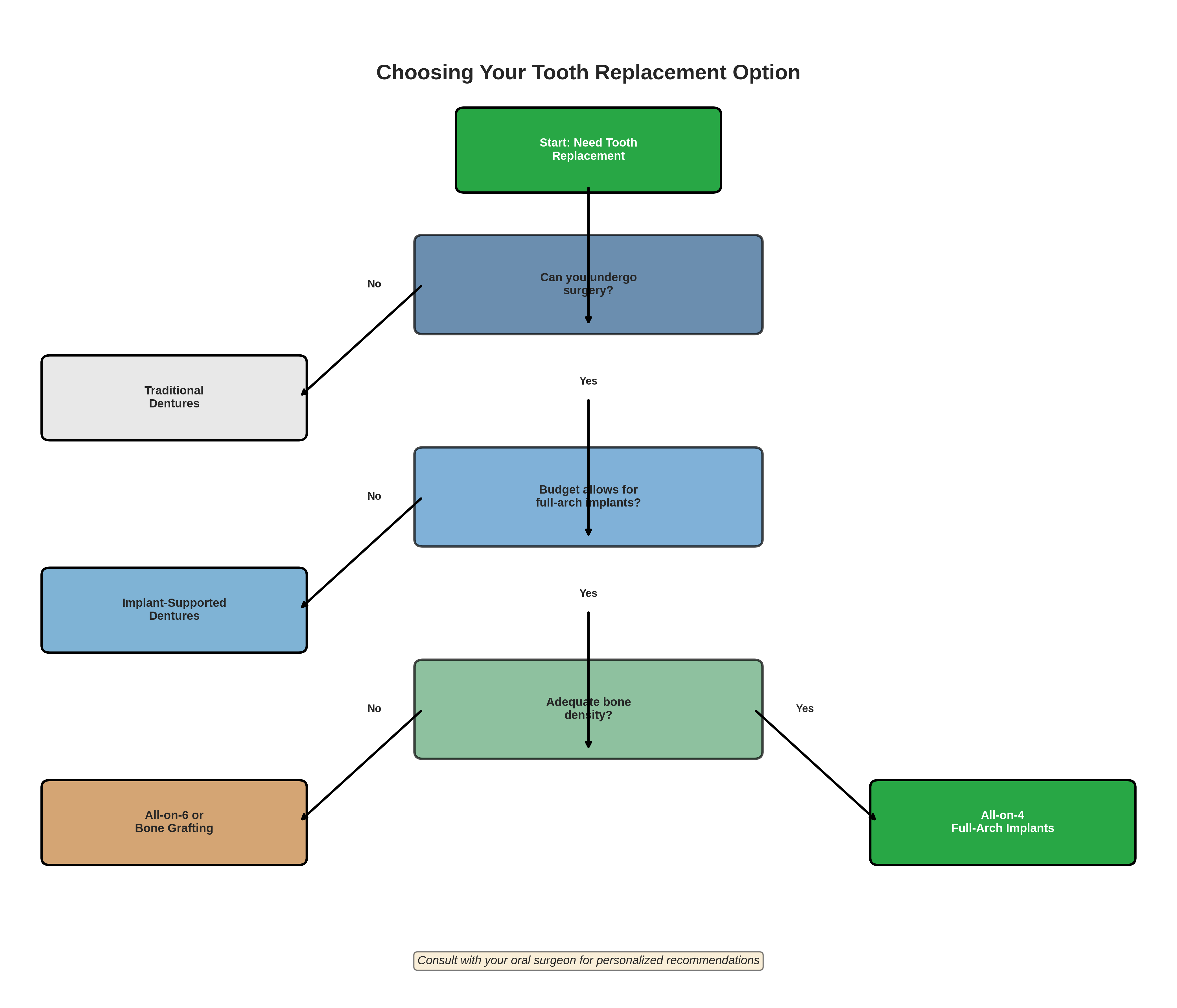
7.9 Decision-Making Framework
Choose Full-Arch Implants If: Seeking Most Permanent Solution:- Want lifetime tooth replacement
- Desire stability and security
- Value predictability
- Prefer fixed solution
- Want best long-term option
- Understand importance of bone health
- Want to maintain facial structure
- Desire long-term stability
- Prevent progressive bone loss
- Protect future options
- Want to eat all foods
- Value natural appearance
- Seek optimal chewing efficiency
- Want clear speech
- Desire confident smile
- Have financial resources
- Understand long-term value
- Can access financing
- Have insurance coverage
- View as worthwhile investment
- Will maintain oral hygiene
- Attend regular appointments
- Follow care instructions
- Value preventive care
- Understand maintenance importance
- Enjoy varied diet
- Value nutritional freedom
- Want to eat socially
- Desire food enjoyment
- Need proper nutrition
- Limited financial resources
- Cannot afford implants
- Need immediate solution
- No financing available
- Cost is deciding factor
- Medical contraindications
- Fear of surgery
- Cannot take time off
- Prefer non-surgical option
- Health limitations
- Uncontrolled diabetes
- Active cancer treatment
- Severe osteoporosis
- Immunodeficiency
- Other health issues
- Urgent tooth replacement needed
- Cannot wait for healing
- Time constraints
- Immediate function required
- Quick solution preferred
- Want to remove teeth
- Prefer cleaning out of mouth
- Like control of removal
- Psychological preference
- Personal choice
- Avoid surgery
- Prefer conservative approach
- Minimal intervention desired
- Less complex treatment
- Simpler process
Conclusion
Module 7 has provided a comprehensive comparison of full-arch dental implants and traditional dentures across all relevant factors. While dentures offer lower upfront costs, implants provide superior function, aesthetics, bone preservation, and long-term value.
The choice between implants and dentures depends on individual circumstances, priorities, and resources. Understanding the complete picture—including long-term costs, functional differences, and quality of life impacts—empowers informed decision-making.
For most patients who are candidates and can manage the investment, full-arch dental implants represent the gold standard in complete tooth replacement, offering the closest approximation to natural teeth and the best long-term outcomes.