Module 4: Financial Planning and Investment in Your Smile
Introduction
Welcome to Module 4, where we address one of the most important practical considerations in your full-arch dental implant journey: the financial investment. We understand that cost is a significant factor in your decision-making process, and our commitment to transparency means providing you with comprehensive, honest information about what to expect.
At St. Louis South Oral & Maxillofacial Surgery, we believe that financial clarity empowers confident decisions. This module explores not just the upfront costs, but the long-term value, insurance considerations, financing options, and return on investment that full-arch dental implants represent.
Whether you're a patient planning your treatment budget, a referring dentist counseling patients on financial aspects, or a healthcare professional seeking to understand the economic considerations, this module provides the detailed information you need.
Learning Objectives
By the end of this module, you will be able to:
- Understand the complete cost structure of full-arch dental implants as of 2025
- Compare costs with alternative treatments over short and long-term timeframes
- Navigate insurance coverage and maximize available benefits
- Explore financing options and payment plans
- Appreciate the return on investment beyond just financial considerations
- Make informed financial decisions about your oral health investment
4.1 Understanding Full-Arch Implant Costs (2025)
Current Pricing Landscape
As of 2025, full-arch dental implant costs reflect the advanced technology, specialized expertise, and high-quality materials involved in this transformative treatment. Understanding the investment helps you plan appropriately and evaluate the value proposition.
Average Costs for Full-Arch Implants:- Single arch restoration: $20,000 to $35,000
- Total mouth restoration (both arches): Up to $60,000
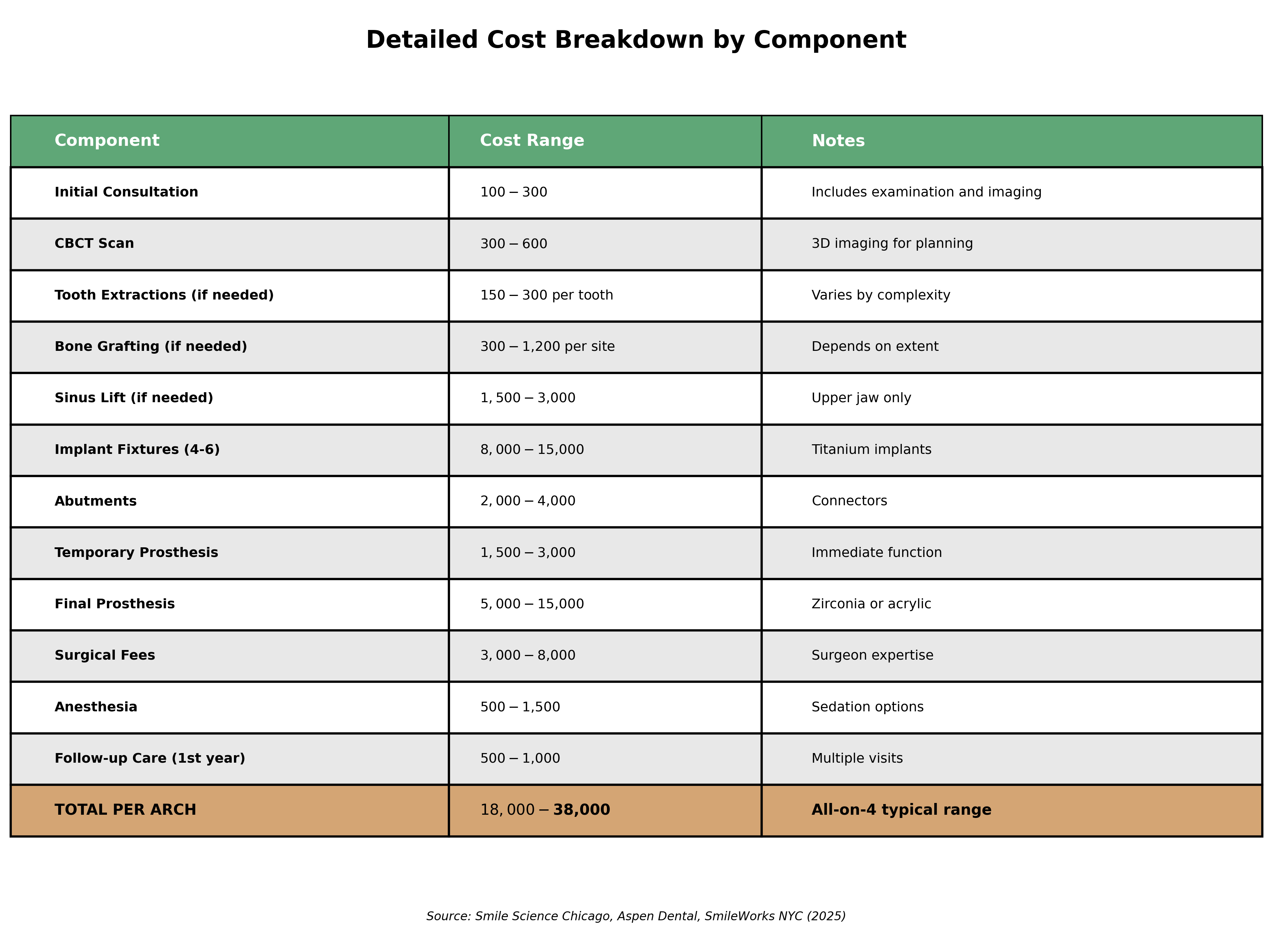
- All-on-4 single arch: $18,000 to $38,000
- All-on-6 single arch: Higher than All-on-4 due to additional implants
These ranges reflect national averages and can vary based on multiple factors we'll explore below.
Specific Provider Pricing Examples (2025):To give you a sense of real-world pricing:
- Aspen Dental: $14,617 to $29,902 per arch
- Max Arocha DMD: Starting at $24,889 per arch
- NYC pricing (SmileWorks): $25,000 to $60,000 for full-mouth restoration
Geographic location significantly impacts pricing, with urban areas and coastal regions typically commanding higher fees than rural or midwest locations.
Cost Variation Factors
Understanding why costs vary helps you evaluate quotes and make informed comparisons:
Geographic Location:- Urban vs. rural pricing differences
- Regional cost of living impacts
- Local market competition
- State-specific regulations and overhead
- Bone quality and quantity
- Need for preparatory procedures
- Number of implants required
- Anatomical challenges
- Medical complexity
- Zirconia prostheses: Higher cost but superior aesthetics and durability
- Acrylic prostheses: More affordable with good results
- Hybrid materials: Mid-range pricing
- Implant brand and quality: Premium vs. standard implants
- Tooth extractions: $150-$400 per tooth typically
- Bone grafting: $300-$3,000 depending on extent
- Sinus lift procedures: $1,500-$3,000 per side
- CT scans and imaging: $300-$600
- Temporary prostheses: $500-$2,000
- Board-certified oral surgeons may charge premium fees
- Specialized training and experience
- Advanced technology and techniques
- Practice reputation and outcomes
- Continuing education and expertise
- State-of-the-art surgical facilities
- Advanced imaging technology (CBCT)
- Computer-guided surgery systems
- Digital workflow integration
- Accreditation and safety standards
What's Included in the Cost
Understanding what your investment covers helps you evaluate value:
Pre-Surgical Phase:- Comprehensive consultation
- CBCT 3D imaging
- Digital treatment planning
- Diagnostic records
- Treatment plan development
- Anesthesia (IV sedation or general)
- Surgical procedure
- Implant hardware (implants, abutments)
- Temporary prosthesis (if immediate loading)
- Post-operative medications
- Follow-up appointments
- Final impressions or digital scans
- Laboratory fabrication
- Try-in appointments
- Final prosthesis
- Delivery and adjustments
- Some practices include first-year follow-ups
- Initial maintenance visits
- Adjustments as needed
What May Cost Extra
Be aware of potential additional costs:
- Preparatory procedures (extractions, grafting)
- Sedation upgrades
- Premium prosthetic materials
- Extended warranties
- Replacement of temporary prosthesis if damaged
- Treatment of complications (rare)
4.2 Cost Comparison: Implants vs. Alternatives
Traditional Dentures: The Lower Upfront Cost
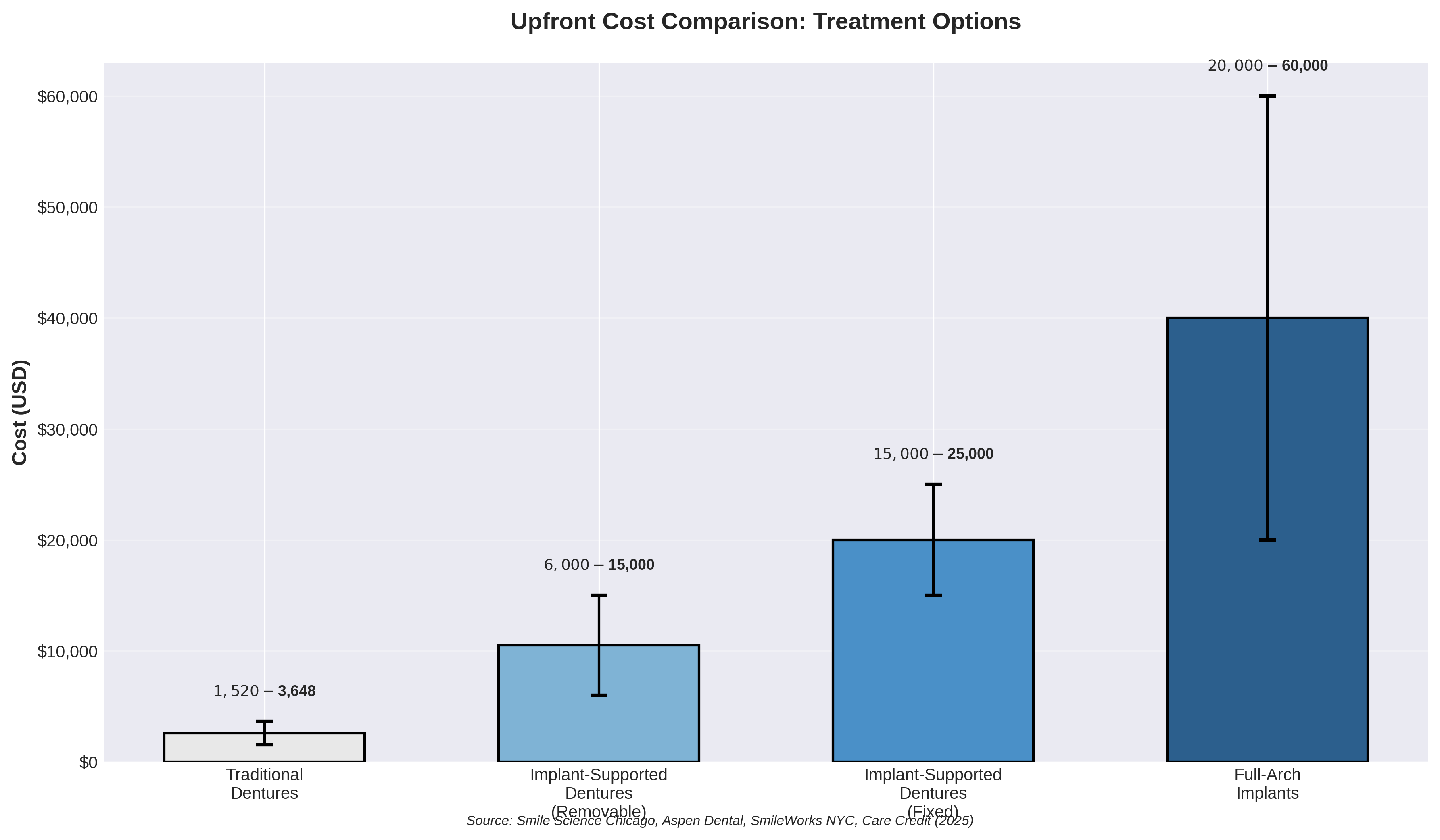
Initial Investment:- Average cost per arch: $1,968 (2025)
- Cost range: $1,520 to $3,648 per arch
- Full mouth: $3,040 to $7,296
Traditional dentures have a significantly lower upfront cost, which makes them initially attractive. However, the complete financial picture requires looking beyond the initial investment.
Replacement Frequency:- Typical lifespan: 5-7 years
- Replacement needed: Every 5-7 years due to wear and bone changes
- Relines required: Every 1-2 years ($300-$500 each)
- Adjustments: Frequent adjustments needed
- Denture adhesives: $10-$30 per month ($120-$360 annually)
- Cleaning products: $10-$20 per month ($120-$240 annually)
- Repairs: $100-$500 as needed
- Relines: $300-$500 every 1-2 years
- Replacements: $1,520-$3,648 every 5-7 years
Implant-Supported Dentures: The Middle Ground
Removable Implant-Supported Dentures:- Cost per arch: $6,000 to $15,000
- Characteristics: Snap onto implants but removable
- Advantages: Better stability than traditional dentures
- Maintenance: Still require removal and cleaning
- Cost per arch: $15,000 to $25,000
- Characteristics: More stable than removable options
- Advantages: Better function than traditional dentures
- Considerations: Still may have some limitations vs. full-arch implants
Full-Arch Implants: The Premium Investment
Initial Investment:- Cost: $20,000 to $60,000 for complete treatment
- Higher upfront: Significantly more than alternatives
- Comprehensive solution: Includes all components for permanent restoration
- Minimal ongoing costs: Regular cleanings and maintenance
- No replacements needed: Implants can last lifetime
- Prosthesis longevity: May need replacement in 10-15 years ($3,000-$8,000)
- Maintenance: Professional cleanings ($150-$300 per visit, 2-4 times yearly)
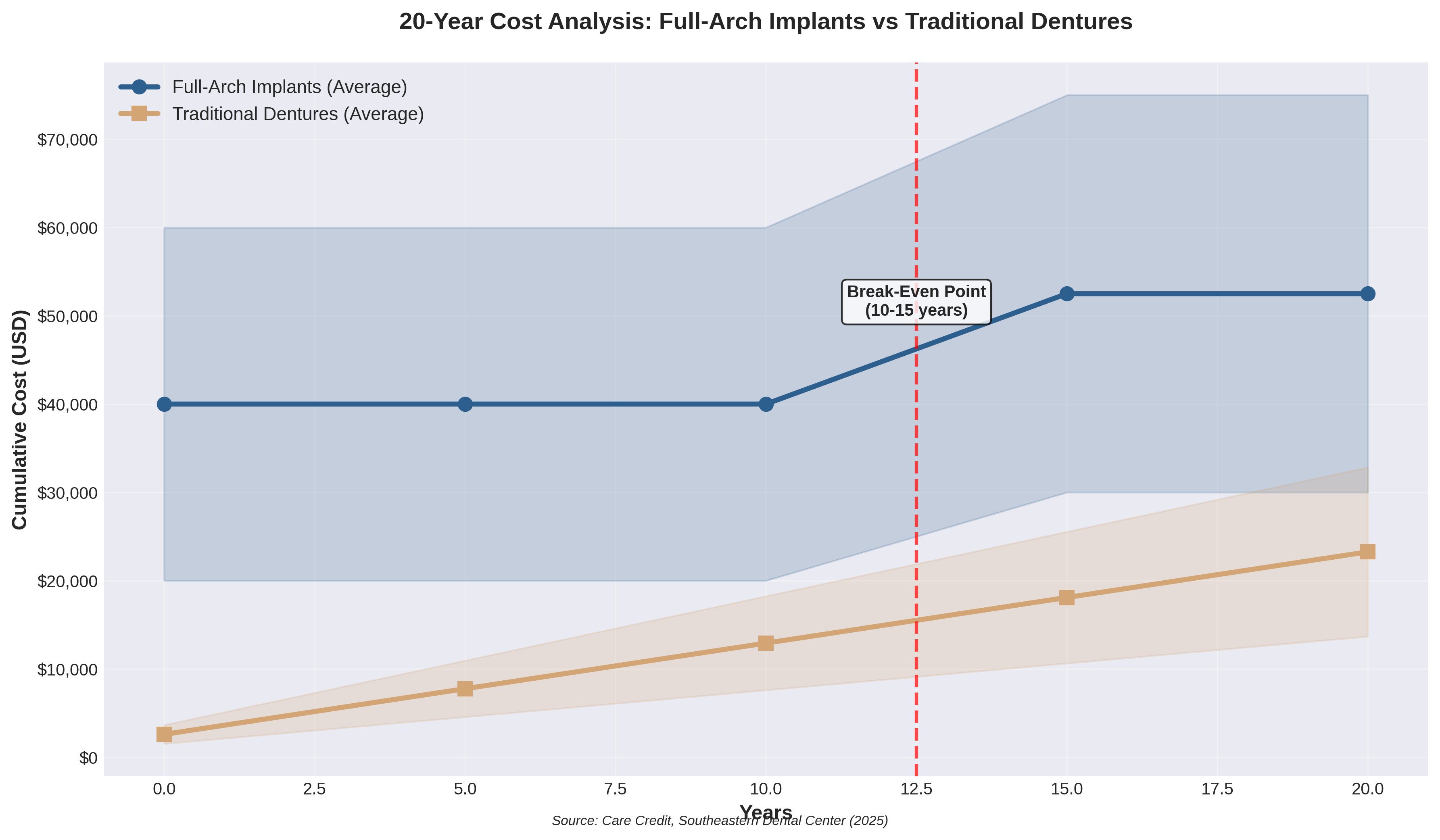
20-Year Cost Analysis: The Complete Picture
Let's examine the total cost of ownership over 20 years:
Traditional Dentures (20 Years):- Initial dentures: $3,040-$7,296
- Replacements (3-4 sets): $4,560-$14,592
- Relines (10-15): $3,000-$7,500
- Adhesives (20 years): $2,400-$7,200
- Repairs and adjustments: $1,000-$3,000
- Total 20-year cost: $14,000-$39,588
- Initial investment: $20,000-$60,000
- Maintenance cleanings: $6,000-$14,400
- Possible prosthesis replacement (once): $3,000-$8,000
- Total 20-year cost: $29,000-$82,400
- Break-even point: Typically occurs at 10-15 years
- After break-even: Implants become more cost-effective
- Lifetime value: Implants provide superior value over 20+ years
The Value Beyond Cost
While the numbers are important, they don't capture the complete value proposition:
Functional Value:- Superior chewing efficiency
- No dietary restrictions
- Better speech
- No slipping or clicking
- Natural feel and function
- Bone preservation
- Better nutrition
- Improved overall health
- Reduced risk of additional dental problems
- Confidence and self-esteem
- Social comfort
- Professional advantages
- Psychological well-being
- Freedom from denture worries
4.3 Insurance Coverage and Maximization
Understanding Dental Insurance Coverage
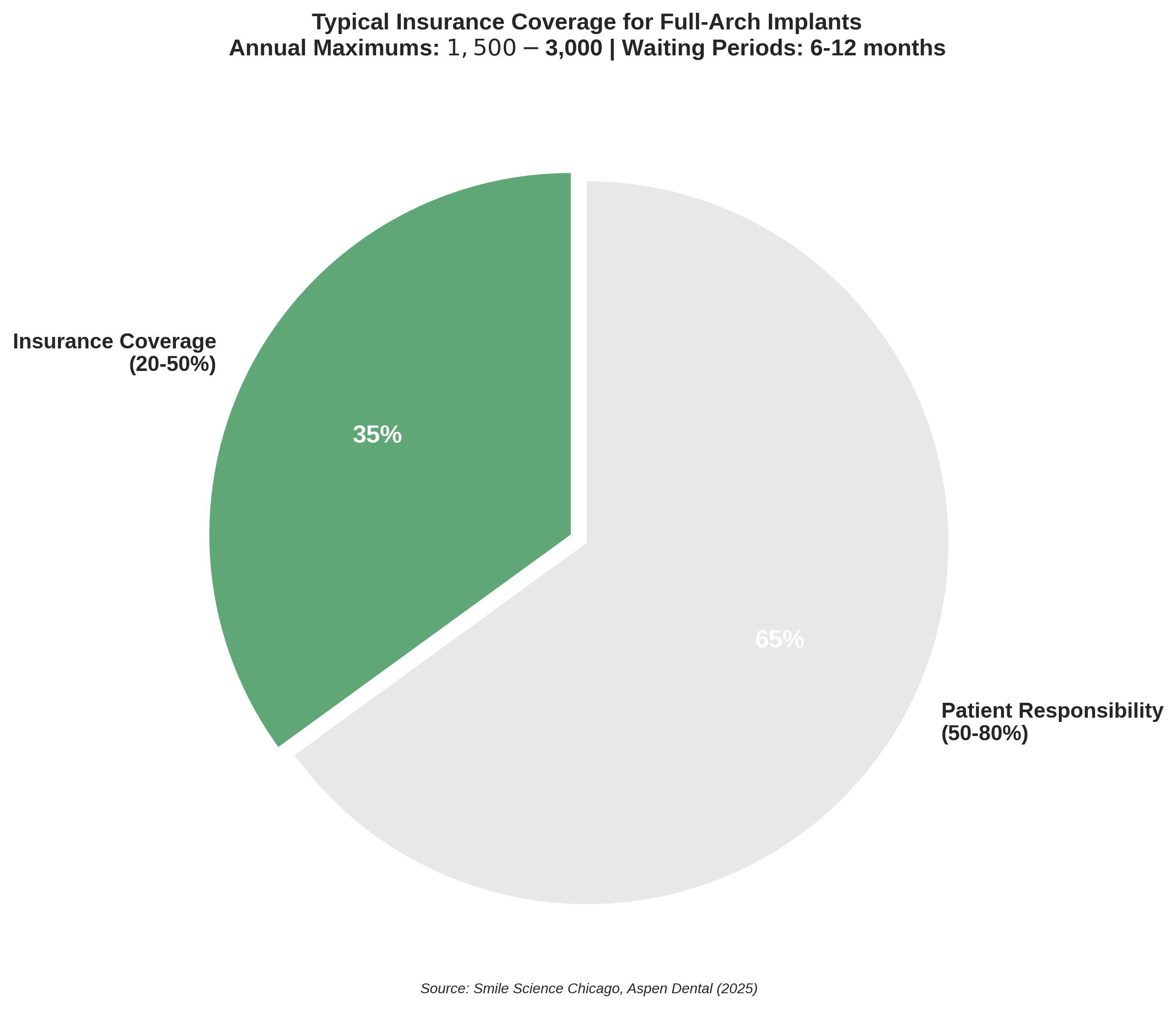
Typical Coverage for Implants:As of 2025, dental insurance coverage for implants varies significantly:
- Coverage percentage: Typically 20% to 50% of implant costs
- Annual maximums: Usually $1,500 to $3,000 per year
- Classification: Most plans classify implants as "major" procedures
- Waiting periods: 6-12 months common for major procedures
- Percentage covered: 50% after deductible is common
- Annual maximum applies: Limits total benefit per year
- Pre-authorization required: Most plans require pre-approval
- Documentation needed: X-rays, treatment plans, medical necessity justification
- Some plans explicitly exclude implants
- Cosmetic procedures typically not covered
- Missing tooth clauses may apply
- Age restrictions in some plans
- Frequency limitations
Maximizing Your Insurance Benefits
Strategic Planning: Multi-Year Treatment Planning:- Spread treatment across multiple benefit years
- Maximize annual benefits each year
- Example: Extractions/grafting year 1, implants year 2, prosthesis year 3
- Coordinate with benefit renewal dates
- If you have coverage through multiple sources (spouse's plan, etc.)
- Coordinate benefits between plans
- Primary and secondary coverage can increase total benefit
- Understand coordination of benefits rules
- Submit treatment plan for pre-authorization
- Understand exactly what will be covered
- Identify out-of-pocket costs before proceeding
- Appeal denials with additional documentation if needed
In some cases, medical insurance may provide coverage:
- Trauma-related tooth loss: May be covered
- Congenital conditions: Sometimes covered
- Cancer treatment effects: May qualify for coverage
- Accident-related: Often covered under medical insurance
- Document functional impairment
- Emphasize health impacts
- Provide comprehensive medical history
- Include physician letters if applicable
- Understand denial reasons
- Provide additional documentation
- Emphasize medical necessity
- Consider peer-to-peer review
- Escalate through appeal process if warranted
Working with Your Oral Surgery Practice
Financial Coordination:Most practices have financial coordinators who:
- Verify insurance benefits
- Submit pre-authorizations
- Maximize coverage strategies
- Handle insurance communications
- Provide accurate cost estimates
- Request detailed cost breakdowns
- Understand what's covered vs. out-of-pocket
- Get everything in writing
- Ask questions about any unclear charges
4.4 Financing Options
Third-Party Healthcare Financing
CareCredit and Similar Programs: Promotional Interest-Free Periods:- 12-24 months 0% interest: Common promotional offers
- No interest if paid in full: Within promotional period
- Deferred interest: Interest may apply retroactively if not paid in full
- Credit approval required: Based on credit score and income
- Up to 60 months: Longer-term financing available
- Fixed monthly payments: Predictable budgeting
- Interest rates vary: Based on credit tier and term length
- Various credit tiers: Options for different credit profiles
- Immediate treatment possible
- Manageable monthly payments
- Quick approval process
- Accepted at many dental practices
- Can be used for family members
- Read terms carefully
- Understand deferred interest implications
- Make payments on time
- Consider total interest paid on longer terms
In-Office Payment Plans
Many practices offer their own financing:
Practice-Specific Plans:- Down payment: Typically 10-30% required
- Monthly payments: Spread over 6-24 months
- Interest rates: May be lower than third-party financing
- No credit check: Some practices offer this option
- Flexible terms: Can often be negotiated
- Direct relationship with practice
- Potentially more flexible
- May avoid credit checks
- Simpler process
Health Savings Accounts (HSA) and Flexible Spending Accounts (FSA)
Using Pre-Tax Dollars: HSA Benefits:- Tax-free contributions: Reduce taxable income
- Tax-free withdrawals: For qualified medical expenses
- Rollover allowed: Unused funds carry over year to year
- Investment potential: Can invest HSA funds
- Dental implants qualify: Eligible expense
- Pre-tax contributions: Reduce taxable income
- Immediate access: Full annual amount available immediately
- Employer contributions: Some employers contribute
- Dental implants qualify: Eligible expense
- FSA use-it-or-lose-it: Must use funds within plan year (some allow small carryover)
- Contribution limits: Annual limits apply ($3,050 FSA, $4,150 individual HSA for 2025)
- Planning required: Coordinate treatment timing with account funding
Discounts and Promotions
Available Discounts: Cash Payment Discounts:- 5-10% typical: For paying in full upfront
- Saves practice costs: Credit card fees, billing costs
- Negotiable: Ask about cash discounts
- Package pricing: Discount for treating both arches
- 10-15% savings: Common for full-mouth restoration
- Special offers: Practices may run periodic promotions
- Example: Aspen Dental offers 20% off promotions
- Timing: Watch for end-of-year or seasonal offers
- Age-based discounts: Some practices offer senior discounts
- 5-10% typical: Varies by practice
- Ask about availability: Not always advertised
Creating Your Financial Plan
Steps to Financial Preparedness:- Get comprehensive cost estimate: Include all phases and potential additional costs
- Verify insurance benefits: Understand exactly what's covered
- Explore all financing options: Compare terms and total costs
- Consider tax-advantaged accounts: HSA/FSA if available
- Evaluate timing: Multi-year planning may maximize benefits
- Create realistic budget: Ensure monthly payments are sustainable
- Plan for contingencies: Set aside funds for unexpected costs
4.5 Return on Investment Analysis
Financial ROI: The Numbers
Break-Even Analysis:Comparing implants to dentures over time:
Year 5:- Implants: $20,000-$60,000 + $1,500-$3,600 maintenance = $21,500-$63,600
- Dentures: $3,040-$7,296 + $1,200-$1,800 adhesives + $600-$1,000 relines = $4,840-$10,096
- Dentures ahead financially
- Implants: $20,000-$60,000 + $3,000-$7,200 maintenance = $23,000-$67,200
- Dentures: $6,080-$14,592 (2 sets) + $2,400-$3,600 adhesives + $1,500-$2,500 relines = $9,980-$20,692
- Gap narrowing
- Implants: $20,000-$60,000 + $4,500-$10,800 maintenance + $3,000-$8,000 prosthesis replacement = $27,500-$78,800
- Dentures: $9,120-$21,888 (3 sets) + $3,600-$5,400 adhesives + $2,250-$3,750 relines = $14,970-$31,038
- Approaching break-even
- Implants: $20,000-$60,000 + $6,000-$14,400 maintenance + $3,000-$8,000 prosthesis = $29,000-$82,400
- Dentures: $12,160-$29,184 (4 sets) + $4,800-$7,200 adhesives + $3,000-$5,000 relines + repairs = $19,960-$41,384
- Break-even achieved or approaching
- Implants: Minimal additional costs (maintenance only)
- Dentures: Continued replacement cycle every 5-7 years
- Implants become increasingly cost-effective
Quality of Life ROI: The Intangibles
The true return on investment extends far beyond financial calculations:
Improved Nutrition and Health:- Ability to eat healthy foods: Fresh fruits, vegetables, proteins
- Better overall nutrition: Impacts entire body health
- Reduced health problems: Better nutrition prevents disease
- Healthcare cost savings: Fewer health issues long-term
- Longevity benefits: Better health supports longer, healthier life
- Professional interactions: Confidence in work settings
- Personal relationships: Comfort in social situations
- Dating and romance: Confidence in intimate settings
- Public speaking: No worry about denture movement
- Photographs and videos: Smile freely without self-consciousness
- Career advancement: Confidence impacts professional success
- First impressions: Attractive smile opens doors
- Client interactions: Professional appearance builds trust
- Networking: Comfort in professional social settings
- Earning potential: Studies show attractive smiles correlate with higher earnings
- No worry about slipping: Permanent stability eliminates constant concern
- No embarrassment: Never worry about denture-related incidents
- Mental health benefits: Reduced anxiety improves overall well-being
- Better sleep: No worry about dental problems
- Improved relationships: Less stress benefits all relationships
- Better nutrition leads to better health: Direct health benefits
- Bone preservation: Maintains facial structure and oral health
- Reduced inflammation: Healthy implants vs. ill-fitting dentures
- Better systemic health: Oral health connects to overall health
- Preventive benefits: Avoiding cascade of dental problems
The Priceless Benefits
Some benefits simply can't be quantified:
- Confidence to smile freely: Priceless
- Comfort eating with family and friends: Invaluable
- Freedom from denture worries: Liberating
- Feeling years younger: Transformative
- Improved self-esteem: Life-changing
- Peace of mind: Beyond measure
Key Takeaways
As we conclude Module 4, let's review the essential concepts:
- Full-arch implants represent a significant investment of $20,000-$60,000, with costs varying based on location, complexity, materials, and surgeon expertise.
- Insurance typically covers 20-50% with annual maximums of $1,500-$3,000, requiring strategic planning to maximize benefits.
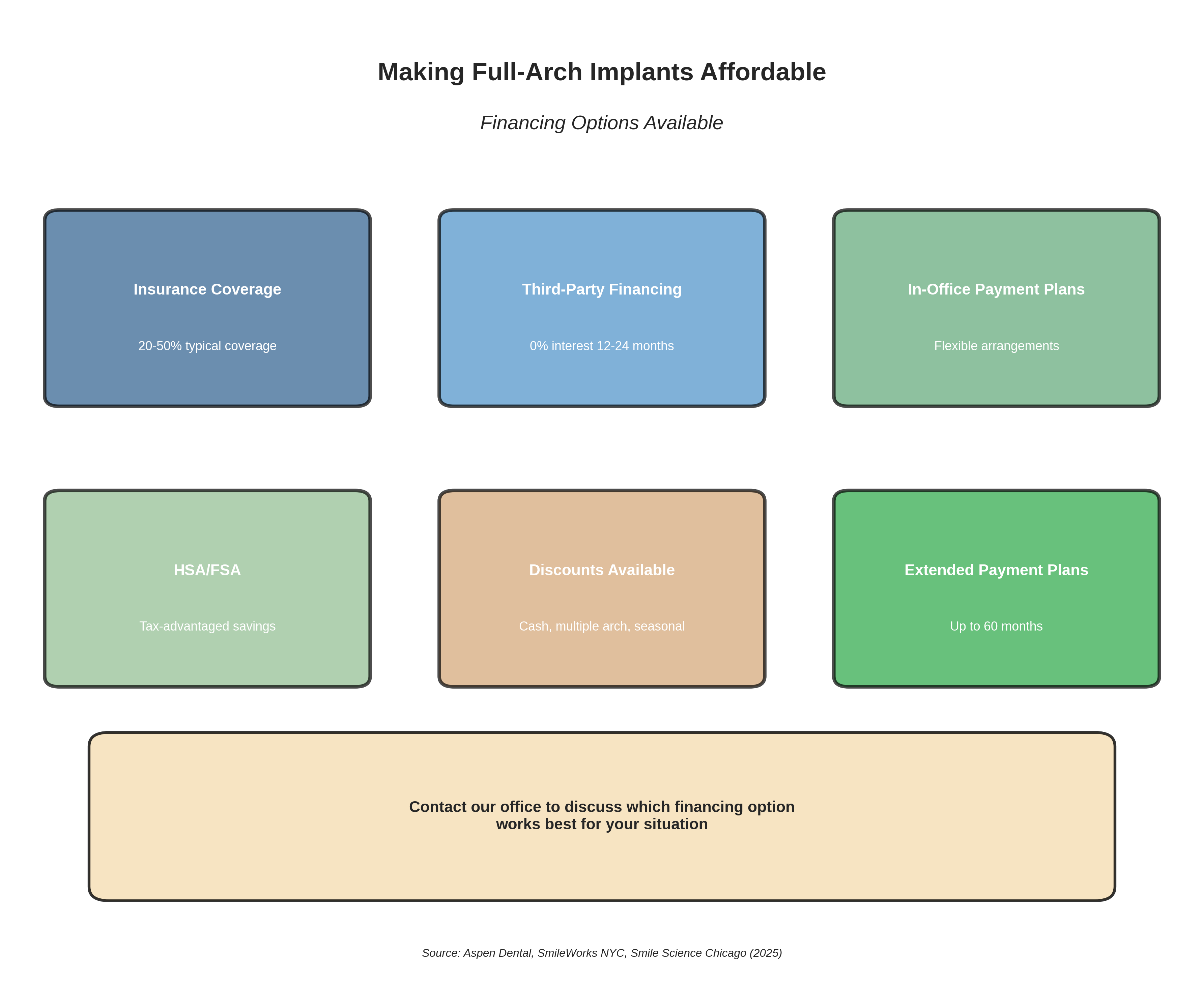
- Multiple financing options available including 0% interest promotional periods (12-24 months), extended payment plans (up to 60 months), and HSA/FSA options.
- Break-even vs. dentures typically occurs at 10-15 years, after which implants become increasingly cost-effective over time.
- Quality of life value extends far beyond financial considerations, including improved nutrition, social confidence, professional advantages, and psychological well-being.
- Long-term cost analysis favors implants when considering 20+ year timeframe and quality of life benefits.
- Strategic financial planning including multi-year treatment timing, insurance maximization, and appropriate financing can make treatment accessible.
- The true ROI includes intangible benefits that significantly impact daily life, relationships, health, and overall happiness.
Reflection Questions
- How does understanding the 20-year cost comparison change your perspective on the initial investment?
- What quality of life benefits are most valuable to you personally?
- How can you strategically plan to maximize insurance benefits and minimize out-of-pocket costs?
- What financing option best fits your financial situation and goals?
Looking Ahead
In Module 5, we'll explore the essential maintenance and long-term care protocols that ensure your investment provides decades of successful function. You'll learn about daily oral hygiene requirements, professional maintenance schedules, and the factors that contribute to long-term implant success.
Visual Content Placeholders
[CHART: Cost Comparison Bar Graph - Implants vs. Dentures over 5, 10, 15, and 20 years]
[PIE CHART: Insurance Coverage Breakdown - Typical coverage percentages and out-of-pocket costs]
[LINE GRAPH: ROI Analysis - 20-year cost comparison showing break-even point]
[INFOGRAPHIC: Financing Options - Visual guide to CareCredit, payment plans, HSA/FSA]
[DIAGRAM: Cost Factors - Breakdown of what influences total treatment cost]
[TABLE: Treatment Cost Comparison - Detailed comparison of implants, implant-supported dentures, and traditional dentures]
[CHART: Quality of Life Value - Visual representation of intangible benefits]
Module 4 Complete Continue to Module 5: Maintenance and Long-Term Care for Implant Success